Two-week engagement · $5,000
AI Systems Audit
A focused, two-week review of your AI stack. Find where you're overspending on tokens, where new agents get stuck on their way to production, and what happens after they ship.

Two-week engagement · $5,000
A focused, two-week review of your AI stack. Find where you're overspending on tokens, where new agents get stuck on their way to production, and what happens after they ship.
You've built some AI agents. They're doing their job. Could they be doing it better? Could they be doing it cheaper? You have assumptions about those questions, but it's hard to know for sure.
Meanwhile, every new agent idea takes weeks to reach production, and once it ships you're not sure whether it's actually working. The costs are rising, the feedback loop is slow, and nobody has a clear picture of the whole system. That's exactly what this audit is built to fix.
I'll map what you're actually running: which agents are in production, the third-party tools and libraries they depend on, and the models and providers behind them. You get a clear inventory of your AI stack, often the first one anyone has written down.
I'll evaluate your readiness level across observability, evals, and the process around building and deploying new agents. Readiness measures how fast you go from idea to deployed agent, and how long after that until you know it's succeeding.
A concrete, ranked set of improvements, like: moving to smaller, faster, cheaper models where they hold up, prompt caching, batch and async APIs, better observability and eval tooling, and context and RAG tuning.
Your AI readiness level comes down to two clocks. Shortening both is the whole game and that's where I'll focus my recommendations.
How long does it take to go from "we should try this" to a working agent running in production? This is your time to market, and it's gated by your tooling, your deployment process, and how much guesswork each new agent requires.
Once an agent ships, how long until you have the confidence to scale it up, or the signal to pull it back? Without observability and evals in place, that answer is often "never." This is where flying blind gets expensive.
Stop paying for a frontier model on a task a smaller one handles just as well. Prompt caching, batch and async APIs, and right-sized models can cut your token spend dramatically.
Tighten the path from idea to deployed agent so your team can ship new capabilities in days instead of weeks, without cutting corners on quality.
With the right observability and evals, you'll know whether an agent is succeeding soon after it ships, so you can confidently double down on what works and fix what doesn't.
You'll walk away with a written report: a full inventory of your AI systems, your readiness score, and a prioritized, actionable roadmap of recommendations, ranked by impact.
I recently put these exact techniques to work on one of my own agents. Using a custom pairwise evaluation tool, I compared model and prompt variations head-to-head and found a configuration that was 95% cheaper and 75% faster than the baseline, with no meaningful drop in quality.
The same playbook (context aware evaluations, iterate to learn, deploy with confidence) is what I bring to your systems.
Read the full write-up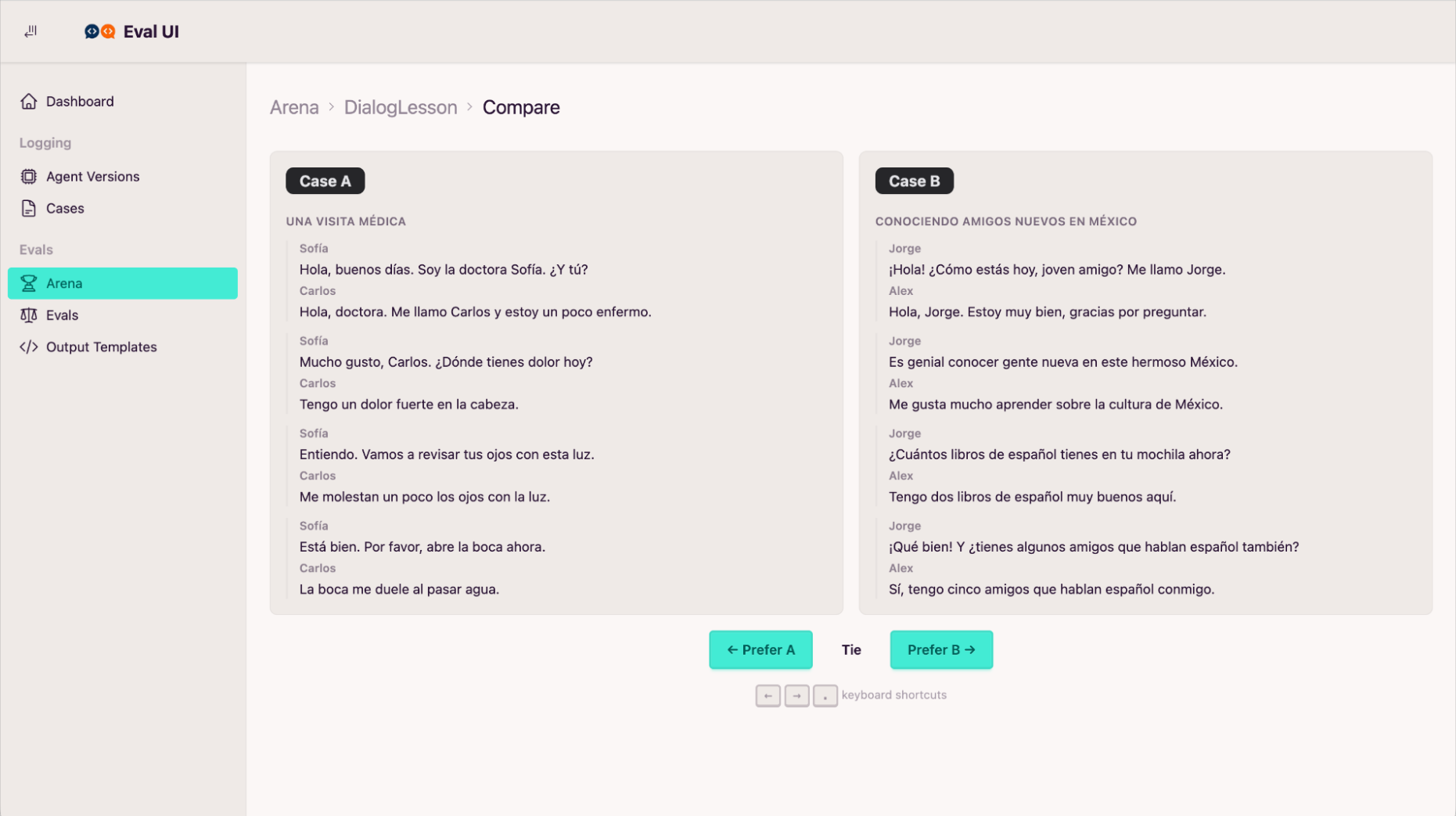
A complete inventory of your AI systems, a readiness score, and a prioritized roadmap to lower costs, ship agents faster, and know sooner whether they work. A fixed scope and a fixed price.
I'm Erik Wiffin, and I've spent the last 15+ years helping startups and scale-ups build software that actually works. These days a lot of that work is AI systems: designing agents, wiring up evals and observability, and helping teams figure out which models and providers are worth the spend.
I've seen what happens when AI features get shipped on vibes and assumptions instead of measurement, and I know how to get you to honest signal fast. This audit distills that experience into a focused two-week engagement.